
State by State · Gaines v. NCAA · testimony
The 2022 NCAA swimming championships, where a male swimmer competed in the women’s events, were held at Georgia Tech. Riley Gaines and other athletes sued the NCAA in federal court in Atlanta, with ICONS as the sole funder, and five plaintiffs testified before the Georgia Senate.
The law in Georgia
Law in force · Covers K-12 and colleges
Georgia law (the Riley Gaines Act, 2025) keeps girls' and women's teams for females in public schools and colleges, and in private schools that play against them. It also requires single-sex locker rooms and overnight rooms on school trips.
Past attempts
2022: HB 1084 passed and signed Apr. 28, 2022, but only authorized the GHSA to act rather than setting the rule in law (Wikipedia summary); GSU Law Review on HB 1084).
The law in detail, with sources
The law
SB 1, the “Riley Gaines Act of 2025.” Passed the Senate Feb. 6, 2025 (35–17) and the House Mar. 31, 2025 (100–64); signed by Gov. Brian Kemp Apr. 28, 2025 (Governor’s release; Lt. Governor’s office; vote counts per Wikipedia summary of the Georgia Recorder/AJC coverage)). Bill page: legis.ga.gov 69274. Effective July 1, 2025 (AJC). Before that, HB 1084 (signed Apr. 28, 2022) let the Georgia High School Association set the rule, and the GHSA voted 62–0 on May 4, 2022 to require students to play by the sex on their birth certificate, effective for 2022–23 (CNN; AJC).
Who it covers
Public K-12 schools, public colleges and universities, and private schools and colleges whose teams compete against public ones (AJC; Riley Gaines Act, Wikipedia).
Notes
Teams must be designated male, female or coed; the law “prohibits both males and females from competing on teams designated for the opposite gender” and requires multi-occupancy restrooms, changing areas and overnight sleeping quarters at school events to be single-sex (Governor’s release). Defines male and female by reproductive biology, bars covered colleges from hosting competitions that let males on women’s teams, bars giving female-team scholarships to males, and provides for a cause of action, complaint investigations and sanctions through the Professional Standards Commission (Wikipedia; Georgia Virtue line-by-line). No court challenge found. The 2022 GHSA rule did not clearly reach private-school athletes; SB 1 covers them directly (AJC).
What ICONS has done in Georgia
- September 29, 2026 · The judge dismissed Gaines v. NCAA; Riley Gaines and ICONS will appeal
- September 26, 2025 · A federal judge denied the NCAA’s motion to dismiss Gaines v. NCAA
- March 10, 2025 · A SurveyUSA poll for ICONS found that 89% of Georgia voters think female-only sports and changing facilities are important
- August 27, 2024 · Georgia’s new Senate committee on women’s sports heard from five NCAA All-Americans who swam at the 2022 championships at Georgia Tech
- March 14, 2024 · ICONS announced it is funding Gaines v. NCAA, brought by 16 current and former college athletes
In the courts and statehouses
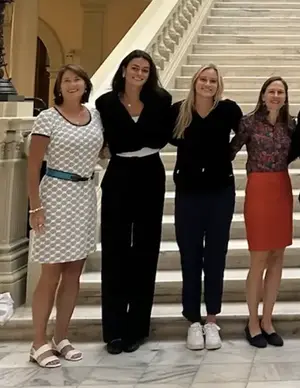
August 27, 2024 · Georgia Senate Special Committee on Protecting Women's Sports
Gaines v. NCAA plaintiffs testify before the Georgia Senate
At the committee's first hearing, at the State Capitol in Atlanta, five plaintiffs in the ICONS-backed Gaines v. NCAA lawsuit testified about competing against and sharing a locker room with a male swimmer at the 2022 NCAA championships, held at Georgia Tech.
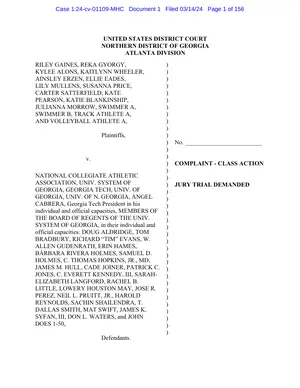
March 14, 2024 · U.S. District Court, Northern District of Georgia
Ruled for NCAA; appeal announced
Riley Gaines and other female athletes sue the NCAA (Gaines v. NCAA)
Current and former college athletes sued the NCAA and Georgia university defendants over NCAA rules that let male athletes compete in women’s events and use women’s locker rooms. ICONS is the sole funder. The court denied the NCAA’s motion to dismiss in September 2025 but ruled for the NCAA on September 28, 2026, finding it is not covered by Title IX. The athletes and ICONS have announced an appeal to the Eleventh Circuit.
“bring this case to secure for future generations of women the promise of Title IX.” From the complaint, p. 2
Outcome: On Sept. 28, 2026, the court granted the NCAA summary judgment, finding it receives no federal funds and so isn't covered by Title IX; the athletes and ICONS announced an appeal to the Eleventh Circuit. Source
Athletes in ICONS-backed lawsuits
- Katie Blankinship, swimming, from Georgia · Gaines v. NCAA
More from ICONS
In the news
- Riley Gaines' lawsuit vs NCAA dismissed by Biden-appointed judge, appeal planned (OutKick, September 29, 2026)
- Riley Gaines Responds To NCAA's Latest Title IX Escape Hatch (The Daily Wire, September 29, 2026)
- NCAA responds after Riley Gaines' lawsuit is dismissed, affirms compliance with Trump's executive order (OutKick, September 29, 2026)
- Riley Gaines v. NCAA lawsuit advances after federal judge partially denies motions to dismiss (Fox News, September 25, 2025)
- One Group Is Funding the NCAA Transgender Ban Lawsuits (Front Office Sports, March 2, 2025)
- Teammate Of SJSU Transgender Volleyball Player Blaire Fleming Joins Lawsuit Against NCAA (OutKick, September 24, 2024)
- Riley Gaines, NCAA athletes to testify in Georgia about competing against, sharing locker room with Lia Thomas (Fox News, August 23, 2024)
- Meet Ainsley Erzen and Marshi Smith – two brave women fighting for biological reality and sanity in women's sports (The Blaze, March 21, 2024)
- Swimmers Lead Independent Council on Women’s Sports Lawsuit over NCAA Transgender Policy (Swimming World, March 15, 2024)
- Current and former college athletes sue NCAA, alleging Title IX violations over transgender policy (CNN, March 15, 2024)
- Female Swimmers Sue NCAA over Male Competition, Demand Return of Trophies, Monetary Damages (The Athletic, March 14, 2024)
- Female Swimmers Sue NCAA over Male Competition, Demand Return of Trophies, Monetary Damages (National Review, March 14, 2024)
- ICONS Files Lawsuit Against NCAA Over Its Transgender Policy; Riley Gaines: We’re Fighting For Young Girls (OutKick, March 14, 2024)
- Riley Gaines and 15 Other Female Athletes Sue NCAA Over ‘Transgender Policy’ (Daily Citizen, March 14, 2024)