
Clear, science-based information on how biological sex shapes athletic performance, for athletes, parents, coaches and policymakers.
“Biological sex is the single most important determinant of athletic performance that is known.”
Dr. Ross Tucker, PhD, physiologist
There is no scientific evidence to support males competing in the women’s category, regardless of testosterone suppression or other interventions.
Jump to: Biology of sex · Testosterone · Testosterone suppression · Sex differences · Before puberty · Sex screening · Fast facts · Research library · Rowing team article
Debunking myths on the biology of sex
Human sex is binary and unchangeable. There are two sexes: male and female. Every human body develops around the formation of large gametes (ova) or small gametes (sperm), whether or not they are ever produced. The developmental paths are antagonistic, and there is no way to reverse, reboot or undo them.
Recognizing this is crucial for fair competition and equal opportunities for women in sports, ensuring that women are recognized as the champions they are.
Read more: Defining vs. Determining Sex, Paradox Institute
Watch
Debunking Myths about the Biology of Sex
Evolutionary biologist Dr. Colin Wright, PhD, at an ICONS conference.
Understanding testosterone
Testosterone levels in males and females do not overlap without an underlying health condition. No female, regardless of PCOS (polycystic ovarian syndrome), will have male levels of testosterone.
The impacts of testosterone on male development begin in utero, continue through infancy and explode during adolescence.
Testosterone levels: no overlap
Healthy women: 0 to 1.7 nanomoles per litre. Women with polycystic ovary syndrome: up to 3.1. Healthy men: 9.2 to 31.8. The female and male ranges do not overlap.
Watch
The Science of Sport, Fair Competition and Testosterone
Dr. Carole Hooven, PhD, Dr. Ross Tucker, PhD, and Dr. Emma Hilton, PhD, at the 2022 ICONS Kickoff Conference.
Testosterone suppression
Males who suppress testosterone and take feminizing hormones do not lose their male biological advantage.
Peer-reviewed review · Sports Medicine, 2021
Transgender Women in the Female Category of Sport: Perspectives on Testosterone Suppression and Performance Advantage
Dr. Emma Hilton, PhD, and Dr. Tommy Lundberg, PhD, reviewed the studies available at the time. After 12 months of testosterone suppression, the loss of lean body mass, muscle size and strength was typically only about 5%.
British Journal of Sports Medicine, 2022
Cardiopulmonary capacity and muscle strength in transgender women on long-term gender-affirming hormone therapy
After an average of 14 years on feminizing hormones, the males in this study (non-athletes) still had about 20% more aerobic capacity and 19% more grip strength than the females.
Sex differences and physiology
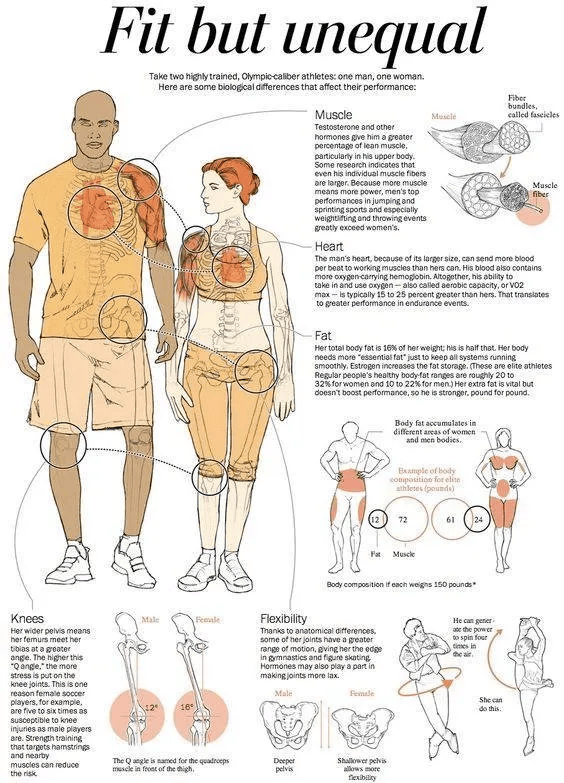
Women and men are equally amazing, but we are working from different biological constraints.
Take the heart. On average, a man’s heart is about 35% heavier than a woman’s and pumps about 30% more blood with each beat. And a woman’s heart isn’t just a smaller version of a man’s: its structure is different too.

Watch
Biological Perspectives on Transgender Athletes in Sport
Physiologist Dr. Ross Tucker, PhD, in May 2022.
Research
- Sex Matters: A Comprehensive Comparison of Female and Male Hearts, Frontiers in Physiology, 2022
- The landscape of sex-differential transcriptome and its consequent selection in human adults, BMC Biology, 2017
- Sex-based differences in skeletal muscle kinetics and fiber-type composition, Physiology, 2015
- Sex-based differences in physiology: what should we teach in the medical curriculum?, Advances in Physiology Education, 2007
Differences before puberty
By age 8, boys run faster, jump farther and throw farther than girls.
It’s often said that boys and girls perform the same until puberty, and many youth leagues mix them. Dr. Greg Brown’s studies of US youth track and field results found a clear gap in every event, years before puberty.

Dr. Greg Brown, PhD
Professor of kinesiology and sport sciences at the University of Nebraska at Kearney. His research with Brandon Shaw and Ina Shaw looks at sex differences in athletic performance before puberty. He spoke at the 2023 ICONS Summit.
Listen: Unveiling Athletic Performance: Boys vs. Girls Before Puberty, Dr. Brown on his research, on the Our Legacy podcast.
Peer-reviewed study · European Journal of Sport Science, 2024
Sex-based differences in track running distances of 100, 200, 400, 800, and 1500m in the 8 and under and 9–10-year-old age groups
Finalists at the USA Track & Field national youth championships, 2016–2023. Boys 8 and under were 4.0–6.7% faster than girls, and boys aged 9–10 were 2.9–5.9% faster. In every event, the fastest boy beat the fastest girl.
Peer-reviewed study · European Journal of Sport Science, 2025
Sex-based differences in shot put, javelin throw, and long jump in 8-and-under and 9–10-year-old athletes
The top eight at the same championships. Boys 8 and under threw the shot 19.3% farther than girls and the javelin 32.6% farther, and long-jumped 4.7% farther. At 9–10 the gaps were 6.5%, 23.5% and 3.9%.
Peer-reviewed study · Scandinavian Journal of Medicine & Science in Sports, 2026
Sex Differences in Running Performance Among 8-and-Under and 9–10-Year-Old Children in US Regional Track Championships
Not just the elite: every runner at all 15 USA Track & Field regional Junior Olympic championships, 2022–2024. Boys were faster at every distance from 100m to 1500m, by 3.8–5.9% at 8 and under and 3.4–5.5% at 9–10.
Do puberty blockers erase the gap?
Not according to the evidence so far. In an expert declaration filed in July 2026, Dr. Brown reviewed about 200 studies. He found no evidence that puberty blockers remove the advantages boys have before puberty, and the data that exist show blockers don’t remove males’ advantages in lean body mass, muscle strength or height. Read his declaration (PDF, 247 pages), filed in K.M.K. v. Washington Interscholastic Activities Association, a girl wrestler’s lawsuit that ICONS supports.
More research on children:sports results and fitness tests in the Research library.
Sex screening
A cheek swab can confirm who is eligible for the female category.
The SRY gene, on the Y chromosome, triggers male development before birth. A test of a cheek swab, saliva or blood shows whether it’s there. World Athletics has required the test for its female category since September 2025, and the International Olympic Committee adopted it in March 2026, starting with the LA28 Olympic Games.
Rules that rely on birth certificates, passports or an athlete’s word can’t be checked, and documents can be changed. Mandatory sex testing in sport ended in 1999. In September 2025, World Athletics reported that 50 to 60 male athletes with differences of sex development (DSD) had reached women’s finals at global and continental championships since 2000.
Editorial · Scandinavian Journal of Medicine & Science in Sports, 2024
Fair and Safe Eligibility Criteria for Women’s Sport
32 researchers, including Dr. Ross Tucker, Dr. Emma Hilton, Dr. Greg Brown and Dr. Mary O’Connor, propose screening every athlete with a cheek swab, early, such as when they first register for the female category, so no one is singled out on suspicion. Eligibility should rest on whether an athlete went through male development, not on testosterone levels, legal sex or gender identity.
Commentary · Scandinavian Journal of Medicine & Science in Sports, 2024
The International Olympic Committee framework on fairness, inclusion and nondiscrimination on the basis of gender identity and sex variations does not protect fairness for female athletes
The IOC’s 2021 framework left eligibility to each sport and started from “no presumption of advantage”. 26 researchers set out why that fails women: males keep their advantages in muscle mass, strength and more, even with testosterone suppressed. The IOC replaced the framework in 2026.
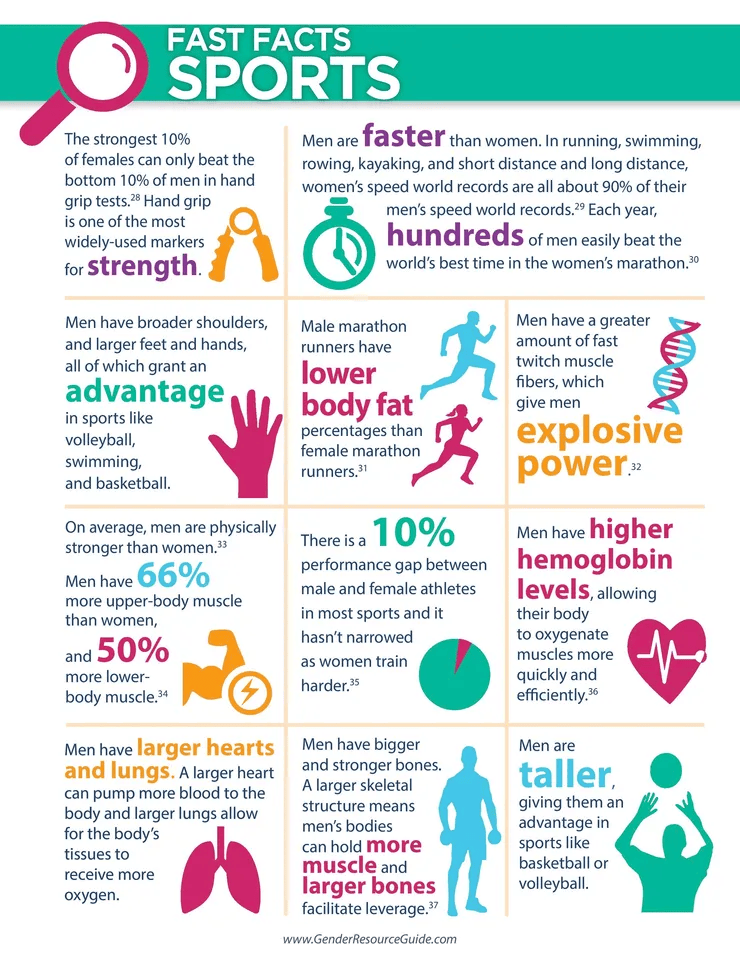
Fast facts
Select a graphic to see it full size.


Further reading
Research library
55 published studies on sex differences in sport, grouped by topic, from testosterone suppression to children’s fitness, with a link to each paper and what it found.
From the ICONS Rowing team
Fairness for Females: Sex Drives Performance
An article on the biology of sex and its relationship to athletic performance, by Mary I. O’Connor, MD, and members of the ICONS Rowing team. With 18 references.